Welcome to Jas and Olive
A collection of floral design learnings, arrangement guides, and musings on plant science

The beauty of a flower is undeniable and arguably universal. Flies, bees, bats, and even geckos are drawn to the allure of flowers. I assume that if you’ve found your way here, you too have been captivated by their charm.
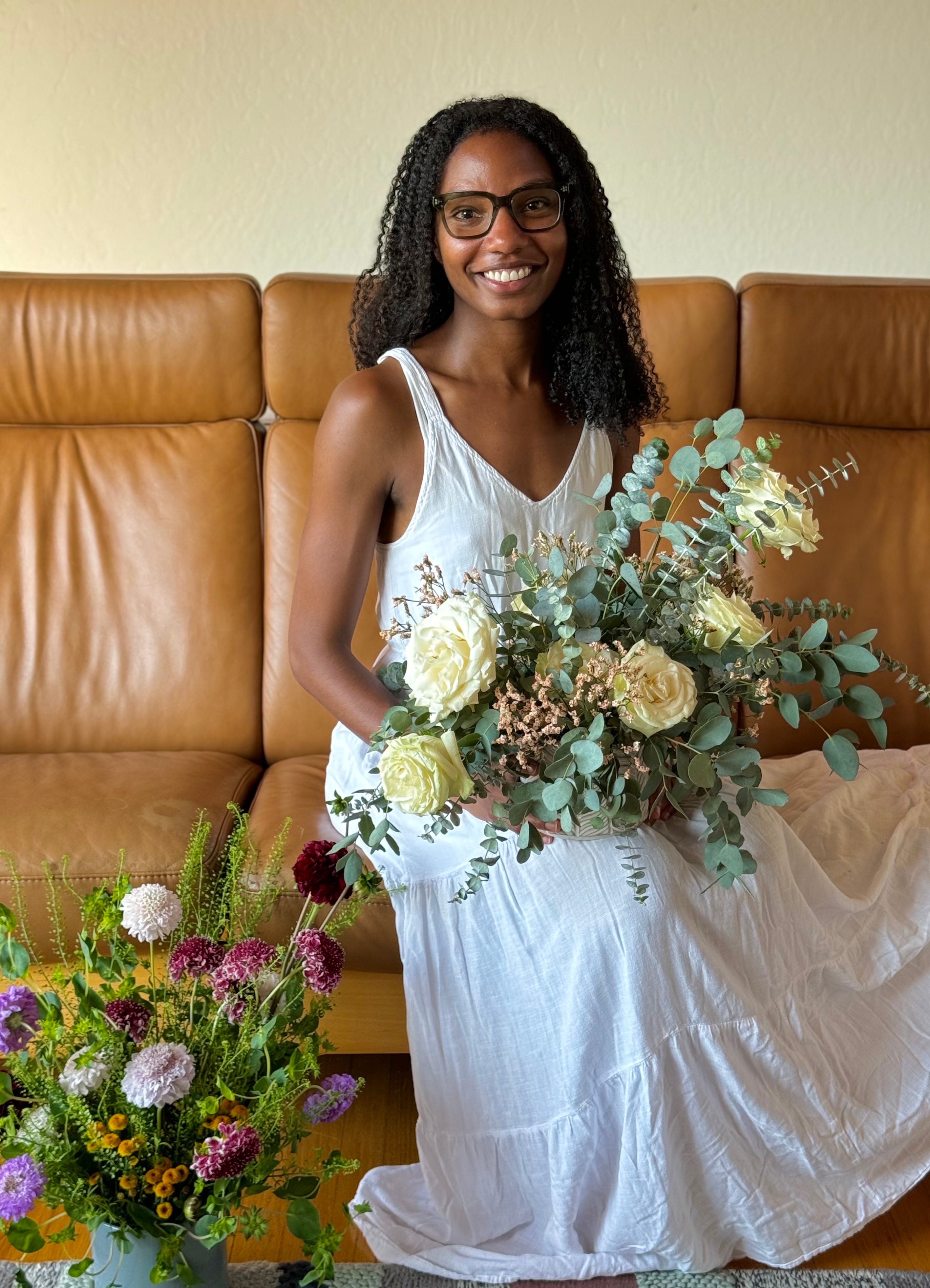
My life’s path resembles more of a zigzag than a straight line. I’ve lived in Miami, Paris, New York City, and now Berkeley, California. I studied international relations and business in college, yet have worked in retail, health and wellness, and the biological sciences. One constant over the years has been my strong belief that you can teach yourself anything. Information is now at our fingertips, making it easier than ever to become an autodidact. This conviction has served me well — from learning about sound engineering and teaching myself how to code as a Co-Founder of TUNE, to understanding the foundational principles of biochemistry as a Lab Lead at Genspace and an Entrepreneur in Residence at Arcadia Science. Similarly, my foray into floral design is fueled by hands-on trial and error rather than by formal classes or a set curriculum.
My approach to creating arrangements differs considerably from what you might see from seasoned designers. I don’t have access to rare and obscure flowers. I aim to spend no more than $50 on a single arrangement and I prefer to follow a stem’s natural movement rather than manipulate it with tools. Often I find myself in a deep rabbit hole, researching the science and evolutionary history of plants. (Recently, I’ve been fascinated by the coevolution of flowers and insects, where the differing color vision of different insect groups applied selective pressure leading to the variety of striking colors we see today.) This different approach has forced me to think deeply about space, movement, relationships, proportions of color and how to mimic a flower’s function in nature in a way that feels unique.
Rest assured, I don’t claim to be an expert florist, but I do think there’s value in learning from others' mistakes and successes. Here’s to hoping that you can learn from mine.


From adversity comes refinement
Loss brought me back to myself.
To myself because I couldn’t make space for us.
A raw truth that hurts like a thorn.
A thorn attached to a rose that will surely bloom.
But winter’s silhouette lingers and reminds me that blooms are not yet in season.
I patiently wait for spring.

//loss
Earlier this year, as I waded through a deeply challenging season of my life, I found great solace in poetry and flowers. I’ve always adored plants, but this felt different. I became sensitive to the subtleties that underscored their beauty — symmetry, texture, flexibility, fragrance, and fleeting blooms sustained by intricate biological mechanisms. As I searched to nurture life, a practice that felt wildly precious at the time, I realized that the flowers were, in fact, nurturing me. From their bloom to their death, the continuous change of cut flowers reminds me to appreciate ephemeral beauty without being left distraught by its impermanence — a practice I will continue to work on for the rest of my life.
Within a few months, I started to bring my arrangements to work and to my surprise, my coworkers would stop by my desk to admire the flowers and comment on the creativity of the designs. Three of my coworkers asked to purchase arrangements for their loved ones and I was encouraged to write a floral design blog by a few friends as I shared my arrangements on social media. Jas and Olive was born.
Jas and Olive: The deeper meaning
The name of this blog, Jas and Olive, is intended to represent a few things. My parents seemed to anticipate my love of flowers and rightfully named me Jasmine. Nearly everyone in my life calls me ‘Jas’ and I invite you to do the same.
‘Olive’ is a nod to my love of biology. Jasmine vines and olive trees both belong to the Oleaceae family – a group of woody plants comprising nearly 700 species which also includes lilacs, ash trees, privets, and osmanthuses. From olives and olive oil to timber from ash trees, the Oleaceae family is home to many species that are economically significant and touch our daily lives. Yet, few of us can recognize their family name.
Despite their importance, most of us know very little about plants and their function in nature more broadly. With Jas and Olive, we’ll explore beyond the foundational principles of floral design and dive into our scientific understanding of plants, touching on topics such as plant-pollinator coevolution, petal symmetry, and plant breeding. Flowering plants, or angiosperms, represent about 80% of all known living green plants. But while you and I are shocked by the breadth of their beauty, Charles Darwin was troubled by their rapid diversification, declaring it an “abominable mystery.” In the century and a half since Darwin’s statement, scientists have discovered far more unique qualities of plants, from their transposable genetic elements to their small molecules that can kill cancer cells. I’m incredibly excited to share with you some of the recent research and advancements in plant molecular biology through the beauty of floral design.
What to expect
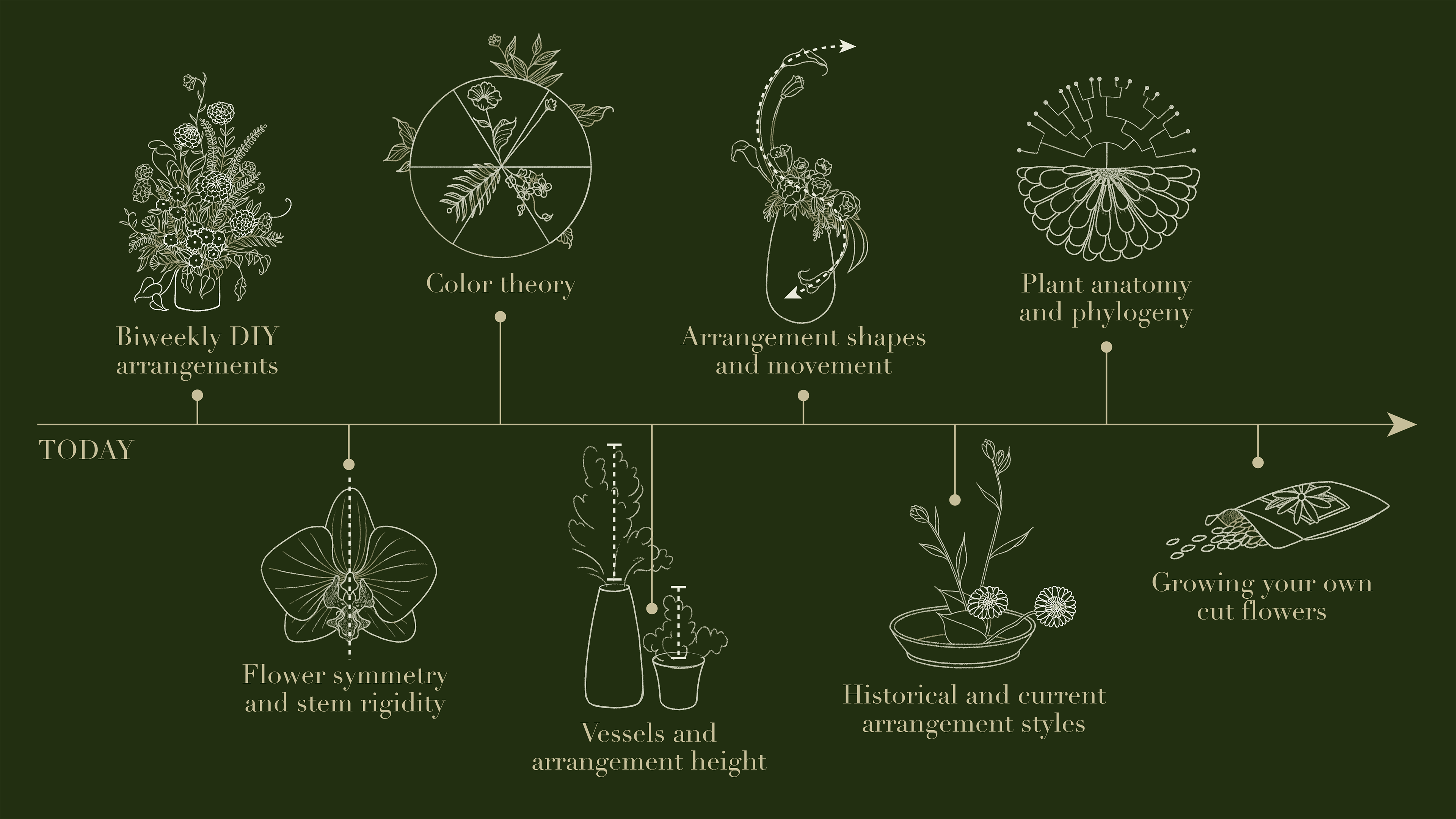
Although I have a long list of content I intend to share, Jas and Olive will surely evolve over time and I welcome you to be a part of this process with me. For now, here’s what I have in mind for us:
Step-by-step instructions for DIY floral designs (including specifics about flower sources, cost, care, and more)
Learnings from my own floral design journey (e.g. color theory, arrangement styles, stem rigidity, vases, texture, etc.)
Monthly features of flowers in season
Musings on cutting edge plant research
Interviews with the leading scientists and founders in the plant molecular biology field
I hope this collection will spark a sense of awe and wonder. If nothing else, may it serve as a useful resource for you to design breathtaking arrangements.
Stay curious. — Jas